Wall Street Journal 9/1/13
By
- ADAM ENTOUS and CAROL E. LEE
 AFP/Getty Images
In this image released by the
White House, President Barack Obama talked on the phone in the Oval
Office with House Speaker John Boehner on Saturday, as Vice President
Joe Biden listened.
After a 45-minute walk Friday night, President
Barack Obama made a fateful decision that none of his top national security advisers saw coming: To seek congressional authorization before taking military action in Syria.
The stunning about-face after a week of U.S. saber rattling risked
not only igniting a protracted congressional fight, which could end with
a vote against strikes, but a backlash from
allies in the Middle East
who had warned the White House that inaction would embolden not only
Syrian President Bashar al-Assad but his closest allies, Iran and
Hezbollah.
Aides said the decision was made by Mr. Obama
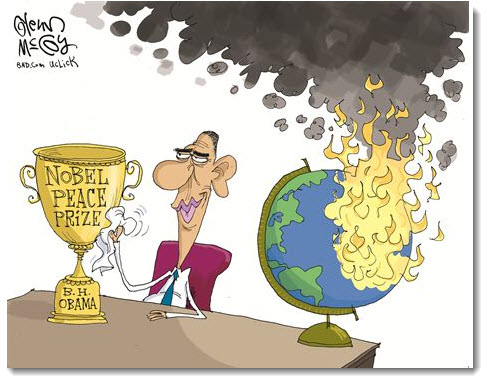
and Mr. Obama alone. It shows the primacy the president places on
protecting his hoped-for legacy as a commander in chief who did
everything in his power to disentangle the U.S. from overseas wars.
Until Friday night, Mr. Obama's national-security team didn't even have
an option on the table to seek a congressional authorization.
The only real discussion was a plan to punish Mr. Assad for what the
U.S. and others have called a chemical-weapons attack amid Syria's
grinding civil war. The final question, policy makers thought, was how
many targets to hit and when to tell the Navy destroyers in the eastern
Mediterranean to open fire.
Yet Mr. Obama made no secret to aides he felt uncomfortable acting
without U.N. Security Council backing. Current and former officials said
his decision reflected his concerns about being seen as acting
unilaterally—without political cover from Congress and without the U.K. at his side. Arab states, for their part, have offered little public support despite their private encouragement.
The change in Mr. Obama's thinking confounded White House insiders.
Some raised concerns about the decision. They asked what would happen if
Congress refused to authorize using force, a senior administration
official said.
The move also took key allies from Israel to Saudi Arabia by
surprise, diplomats said. They thought Mr. Obama was about to pull the
trigger and were preparing for possible retaliation from Mr. Assad.
One official said the biggest concern for the Middle Eastern allies
was that the passage of time during the congressional debate would
reduce the sense of urgency for action.
President Obama said he is in favor of taking
military action against Syria for the alleged use of chemical weapons
against its own people, but that he will seek authorization from
Congress before moving forward.
At a Situation Room meeting of his White
House National Security Council on Aug. 24, three days after the Syrian
bombing raid, Mr. Obama made clear his strong inclination was to take
action.
During one meeting, Gen. Martin Dempsey, the chairman of the Joint
Chiefs of Staff, said something that left an impression on Mr. Obama:
The timing of a strike didn't matter, officials said.
Gen. Dempsey's message to Mr. Obama was that whether the strikes were
launched tomorrow, or a week from now, or a month from now, the
military would be able to ensure the effectiveness of the operation,
officials said.
On Thursday, the White House watched with alarm as U.K. Prime
Minister David Cameron failed to secure parliamentary support for the
U.K. to join the U.S. military operation. The takeaway for White House
officials, aides say, was not to discount the level of war-weariness,
both in the U.K. and at home.
Until Friday night, Mr. Obama's national-security team was focused on
only consulting Congress, rather than seeking a vote on an
authorization to use force. Mr. Obama's team concluded that Mr. Obama
had the legal authority to act without congressional authorization and
was proceeding on that basis.
During his daily wrap-up meeting with Chief of Staff Denis McDonough,
Mr. Obama and Mr. McDonough went on a 45-minute walk around the White
House grounds.
In this image released by the
White House, Mr. Obama met in the Situation Room on Saturday with his
national security advisers to discuss strategy in Syria.
During the walk, Mr. Obama told Mr.
McDonough his thinking—that consulting with Congress wasn't
enough—lawmakers should have to go on the record one way or the other.
Current and former officials said it was no surprise Mr. Obama would
make such an important decision after consulting with Mr. McDonough, who
in his previous role as deputy national security adviser emerged as a
leading voice of caution against intervening in Syria. Mr. McDonough's
successor on the National Security Council has overseen a gradual
expansion of U.S. support to the Syrian opposition, but he doesn't have
as close a relationship with the president.
In meetings devoted to Syria last year, Mr. McDonough would push to
keep the U.S. off the "slippery slope" leading to a potentially
unpopular intervention, according to officials involved in these
meetings. One official, recalling Mr. McDonough's prior role, said "any
time Denis would show his cards a little bit, they would ultimately line
up with where the president would come down."
Dennis Ross, a longtime diplomat who served
with Mr. McDonough in the NSC in the president's first term, said of Mr.
McDonough: "He is very mindful of what the high cost of American
intervention had been. So he approaches the issue of the use of force
with a genuine caution and a genuine concern about really once you do
this, where are you? And how do you get out of it?"
At 7 p.m. Friday, Mr. Obama called his top aides into his office,
including National Security Adviser Susan Rice, to inform them of his
plans. Aides say Mr. Obama came up with the idea himself to seek an
authorization.
Many insiders were stunned because of the risk Congress will say
"no." "You have to win the vote. You have to win," one senior
administration official said after the decision was disclosed. "If
Congress doesn't let him act, the consequences for him and for the
country's standing in the world are enormous."
Later Friday night, Mr. Obama told aides the decision reflected his
growing frustration with lawmakers who appeared to want to have it both
ways—criticizing the president for not seeking congressional
authorization, and then criticizing the decisions he makes.
House Speaker John Boehner (R., Ohio) had sent a letter to Mr. Obama
demanding more consultation with Congress and asking the White House to
clearly lay out the goals of a military mission in advance. Other
Republicans, including Sen. John McCain of Arizona, have said Mr.
Obama's plans for a limited strike didn't go far enough. And still other
lawmakers, including a sizable minority of Mr. Obama's own party in
Congress, have expressed opposition to any intervention in Syria.
Current and former officials said Mr. Obama wanted to force Congress
to make the decision so lawmakers own it as much as the president does.
He also thought the U.S. would be in a stronger position to act in Syria
with Congress's full backing, officials said.
On Saturday, Mr. Obama held a two-hour long meeting of his National Security Council.
Gen. Dempsey repeated his assurances to Mr. Obama that the strikes
can wait. The general told Mr. Obama and his advisers the U.S. military
is confident that there would be no negative impact and that Navy
destroyers could remain in place.
During the past week, White House advisers have said they were moving
fast on Syria. One senior administration official cautioned that
hesitation could embolden Mr. Assad.
"There is an urgency here in our view given that the further you get
away from the event the less the attention is on what took place
actually on the 21st of August and it becomes more about process and
provides an opening for the Syrians and others who support them to
obfuscate and delay and muddy the water," the senior administration
official said earlier this week. "And frankly that sends its own
message, which is you can essentially cover your tracks as it relates to
using chemical weapons."
Mr. Obama made clear during the meeting that the decision was final and in the end, his advisers agreed.
Just before his Rose Garden address, Mr. Obama
called President François Hollande of France. The U.S. still hopes to act with France.
A senior administration official voiced confidence Mr. Assad won't
take advantage of the delay to push ahead with his offensive using
chemical weapons. White House officials also predicted that Congress
would authorize using force, citing the strength of the underlying
intelligence being shared with lawmakers this weekend. With Congress's
blessing, strikes could still be launched, officials said, within weeks.
Source:
http://online.wsj.com/article/SB10001424127887324009304579047542466837078.html?mod=e2fb
There is so much here that is troubling. First, classless to have your feet on the desk ( The Resolute desk is a large, nineteenth-century desk often chosen by presidents of the United States for use in the White House Oval Office as the Oval Office desk. It was a gift from Queen Victoria to President Rutherford B. Hayes in 1880 and was built from the timbers of the British Arctic Exploration ship Resolute. ~ Wikipedia) in the Oval Office. Amazing really. Ronald Reagan would not even take off his suit jacket in the Oval Office out of respect...and Obama I suppose just looks at the desk as some golified Ikea furniture. Absolutely amazing.
Second, the quote: "Aides said the decision was made by Mr. Obama
and Mr. Obama alone. It shows the primacy the president places on
protecting his hoped-for legacy..."
Wow, the sheer depth of the narcissism and hubris, as always to the forefront, FORWARD!
Moral relativism has its limits .....
“The relativism
which is not willing to speak about truth but only about ‘what is
true for me’ is an evasion of the serious business of living. It is
the mark of a tragic loss of nerve in our contemporary culture. It is
a preliminary symptom of death.” ~ Lesslie Newbigin
Remember this?? http://mrc.org/biasalerts/following-syrias-devastating-chemical-weapons-attack-will-media-remember-hillarys-touting
I do agree with Pat Buchanan and his terrific 5 questions:
The questions to which Congress needs answers:
- Do we have incontrovertible proof that Bashar Assad ordered chemical
weapons be used on his own people? And if he did not, who did?
- What kind of reprisals might we expect if we launch cruise missiles at Syria, which is allied with Hezbollah and Iran?
- If we attack, and Syria or its allies attack U.S. military or
diplomatic missions in the Middle East or here in the United States, are
we prepared for the wider war we will have started?
- Assuming Syria responds with a counterstrike, how far are we
prepared to go up the escalator to regional war? If we intervene, are we
prepared for the possible defeat of the side we have chosen, which
would then be seen as a strategic defeat for the United States?
- If stung and bleeding from retaliation, are we prepared to go all
the way, boots on the ground, to bring down Assad? Are we prepared to
occupy Syria to prevent its falling to the Al-Nusra Front, which it may
if Assad falls and we do not intervene?
The basic question that needs to be asked about this horrific attack
on civilians, which appears to be gas related, is: Cui bono?
To whose benefit would the use of nerve gas on Syrian women and
children redound? Certainly not Assad’s, as we can see from the furor
and threats against him that the use of gas has produced.
The sole beneficiary of this apparent use of poison gas against
civilians in rebel-held territory appears to be the rebels, who have
long sought to have us come in and fight their war.
Which makes this news report all the more troubling: http://rt.com/news/sarin-gas-turkey-al-nusra-021/#.UiBSXR_-9vQ.twitter
Along with this tidbit: http://www.worldaffairsjournal.org/blog/gordon-g-chang/punishing-assads-wmd-supplier?utm_source=World+Affairs+Newsletter&utm_campaign=ff2862d4b5-August_28_2013_Blog_Chang_DeOnis_Motyl&utm_medium=email&utm_term=0_f83b38c5c7-ff2862d4b5-294603281
I always find Dr. Tim Stanley's analysis quite insightful. This one is no different.
Syria and al-Qaeda: the enemy of our enemy could turn out to be our most dangerous enemy of all
We've spent the last twelve years fighting a war on terror, by which
we mean a war on al-Qaeda. Now we're proposing intervening in the Syrian
conflict on the side of – wait for it – al-Qaeda. We've lobbed a
grenade at the looking glass and jumped straight through.
The above statement comes with caveats. First, al-Qaeda inspired Islamists are only
one,
unwelcome part of the rebel alliance. Second, any military action the
West carries out will be devised to punish Assad for using chemical
weapons rather than to decisively throw the war in his opposition's
favour. But
the reality is that any intervention into Syria involves
picking sides and so helping one to win, and given that the rebel side
contains all the fundamentalist fruitcakes we are – effectively –
putting ourselves on the side of the crazies who hate us. You know,
those folks who flew planes into the World Trade Centre. Remember them?
These are the kind of people we'd be allying ourselves with in any conflict.
The Islamist rebels hate Christians and have given them the option of "flee or die". In June,
the Catholic priest Francois Murad was murdered by a Syrian opposition group; according to the Vatican, he was beheaded in public while boys and men cheered. This week,
video leaked out of the country purporting to show a roadside execution of three men accused of being insufficiently Muslim.
Their truck was flagged down and they were interrogated to find out if
they were Sunnis or members of the Alawite minority according to their
prayer habits. When they gave the "wrong" responses, they were taken to
the side of the road and shot in the back to shouts of "Allahu Akbar".
The presence of such savages within the rebel ranks threatens to open up
a second civil war within the rebellion itself:
according
to the Syrian Observatory for Human Rights, Kurds and Islamists are
shooting at each other right now in the northeast of the country.
Of course,
Assad has proven himself just as capable of brutality –
he's a vile dictator that the West should have rejected, isolated and
helped drive from office years ago. Had we intervened earlier, when the
opposition was dominated by democrats, we might have compelled proper
elections and created a freer Syria. But a mix of our inaction, Assad's
tenacity, radicalisation and foreign intervention by Islamists has
helped to pollute the rebel faction with religious maniacs. The result
is that we don't know who we're siding with in a war that feels so
depressingly inevitable. The enemy of our enemy could turn out to be our
most dangerous enemy of all.
The prowar lobby keeps saying that if Assad wins the Syrian war there
will be a bloodbath. That's more than likely. But if the rebels win
there will be a bloodbath, too. It's that kind of war: lots of killing
on either side and it all ends in a bit more killing. The only question
is how much blood we in the West want to get on our own hands. I'd
advise, "as little as possible".
Source: http://blogs.telegraph.co.uk/news/timstanley/100233098/syria-and-al-qaeda-the-enemy-of-our-enemy-could-turn-out-to-be-our-most-dangerous-enemy-of-all/
And finally, digusting in it's allegation, but there is certainlt some truth to it, sadly.
http://www.washingtontimes.com/news/2013/sep/1/curl-obamas-2014-calculation-lets-have-war/
What a mess. We need a long range Foreign Policy, not reactionary but prudently proactive that promotes America's values. Under the Obama Administration, our foreign policy appears increasingly schizophrenic, arbitrary, short sighted and confused at best.